CASE STUDY 01 - SPYxFAMILYWhen “Family“ Means “Mission“
01 - SOURCE TEXT
Original Japanese
FAMILY / MISSION
The kanji mean “family“, while the furigana indicate “mission.“A single expression carrying two simultaneous meanings.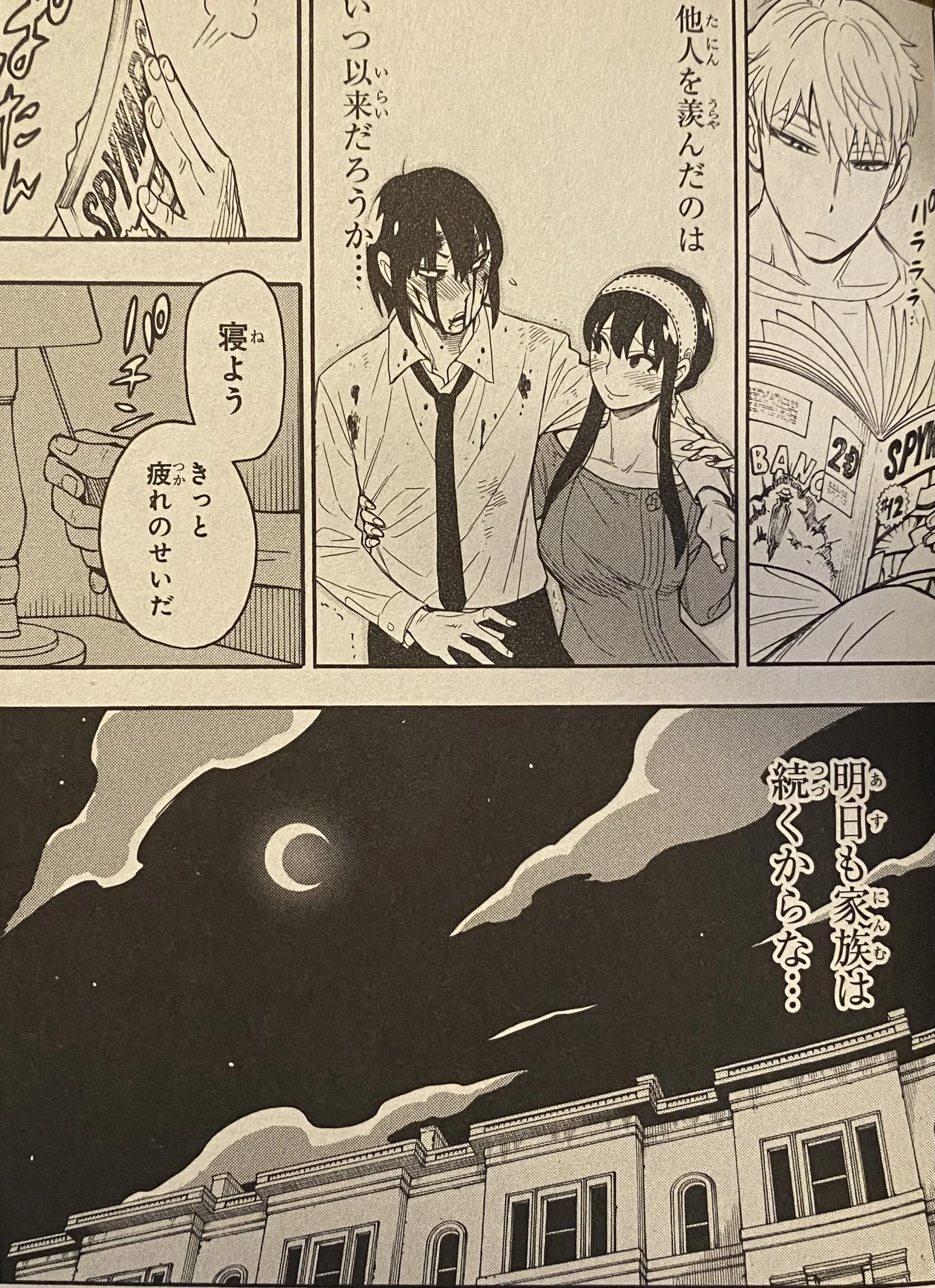
02 - EXISTING TRANSLATIONS
Two Languages, Two Approaches.
German Version
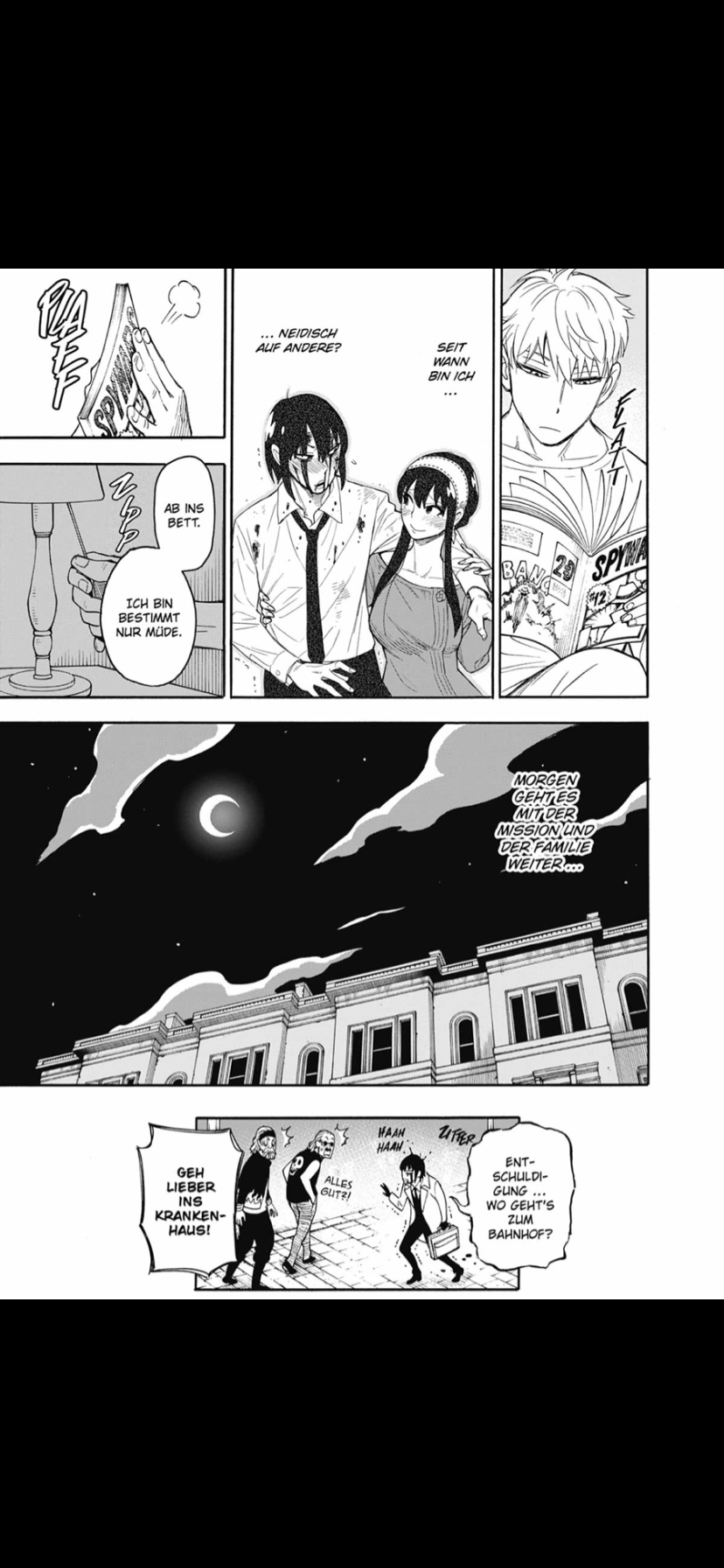
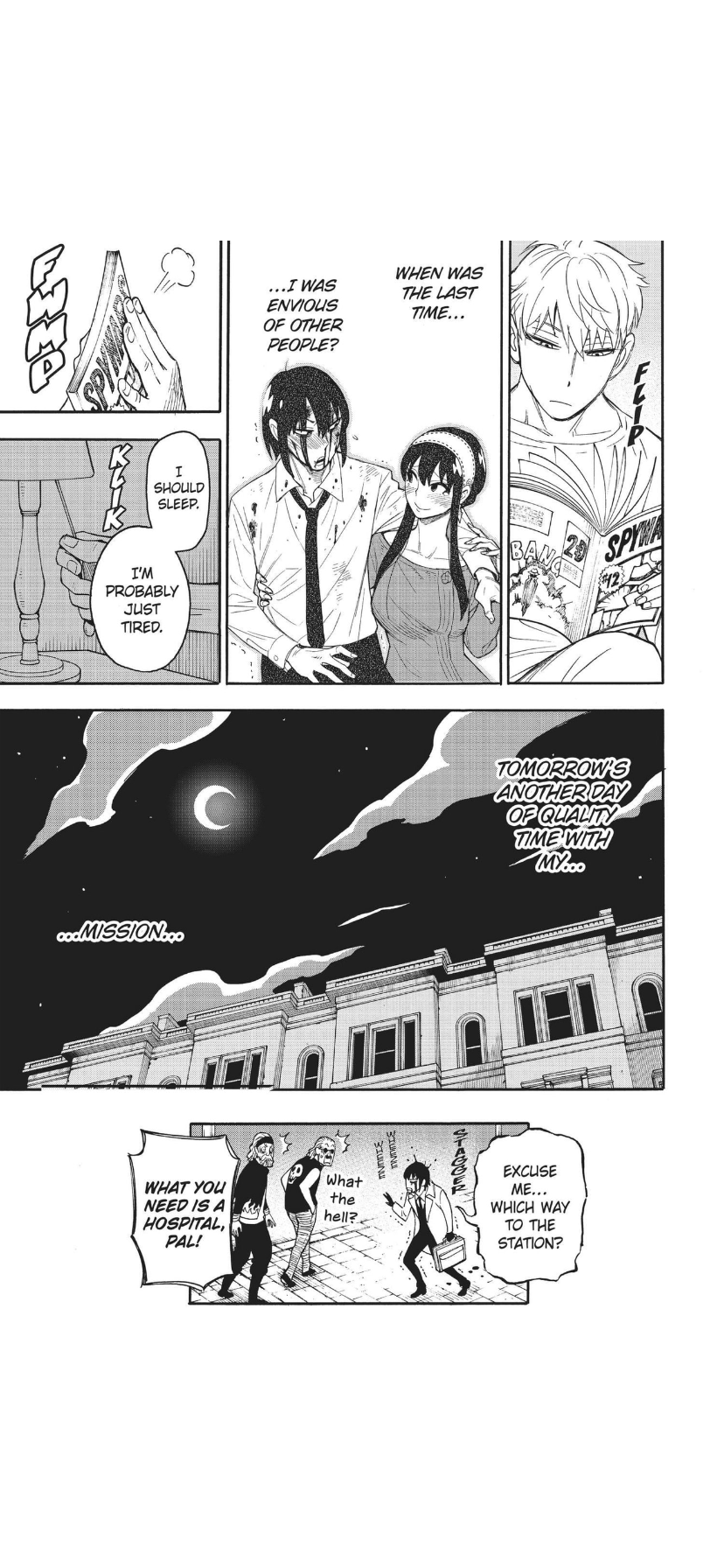
A comparison of the German and English translations, focusing on how each version conveys the dual meaning of the original Japanese expression and Loid’s emotional state.
English Version
03 - LOCALIZATION ANALYSIS
Beyond the Words.
The German Approach
The German translation presents “family” and “mission” as two separate concepts. Although both meanings are retained, the simultaneous relationship between them is lost.
In the Japanese original, family and mission are not simply connected; they are expressed as a single linguistic unit.
How can a translation preserve two simultaneous meanings without altering the emotional nuances of a character?
This case study explores the relationship between Japanese furigana, linguistic ambiguity, and Loid’s emotional development.
The English Approach
The English translation takes a creative approach by using the expression “quality time with my…” followed by “…mission.”
While this effectively conveys the tension between family and duty, it may also suggest that Loid momentarily thinks of his family as a genuine family before correcting himself.
This creates a subtle shift in the portrayal of his emotional state.
04 - The Significance of Furigana
FAMILY = MISSION
In the Japanese original, the kanji 家族 (family) are accompanied by the furigana にんむ (mission). This allows two meanings to coexist simultaneously within a single expression.
Rather than suggesting a transition from “family” to “mission,” this linguistic structure creates an almost equation-like relationship between the two concepts.
In this particular scene, Loid still appears to perceive his family primarily as part of his mission. As the story progresses, however, his genuine emotional attachment to his family becomes increasingly apparent.
Preserving this subtle distinction is particularly important when translating a character whose emotional development is central to the narrative.
05 - My Localization Approach
In my interpretation, Loid has not yet clearly distinguished between family and mission on an emotional level in this particular scene. Although genuine affection may already be emerging, it remains subtle and largely unacknowledged at this stage of the narrative.
Despite its creativity and elegance, the official English translation introduces a temporal shift from “family” to “mission,” which may suggest a slightly more advanced stage of Loid’s emotional development than the Japanese original does.
What I consider particularly important in the original is not so much the emotional hesitation between these two concepts, but the fact that they have not yet become clearly distinct.
My proposed translation
Morgen geht die „Familie“ weiter …
In my own localization, I sought to preserve the semantic overlap and ambiguity of the original by retaining “Familie” as the central term rather than explicitly separating “family” and “mission.”
By deliberately placing quotation marks around “Familie,” I attempted to evoke the function of Japanese furigana through a typographic convention familiar to German-speaking readers.
Although quotation marks cannot fully reproduce the dual meaning created by Japanese furigana, they can suggest an additional layer of meaning without explicitly defining it, leaving room for the reader’s own interpretation.
I also considered a more formal and emotionally detached formulation that would have been closer to Loid’s usual manner of speaking. In this particular scene, however, I wanted to emphasize not his characteristic professional detachment, but the subtle emotional openness that begins to emerge beneath his identity as a spy.
I therefore deliberately chose a more natural and understated formulation.
My objective was not merely to translate the literal meaning of the words, but to preserve the visual storytelling techniques of the original, the character’s stage of emotional development, and the emotional complexity and narrative subtlety characteristic of SPY×FAMILY.
Sources & Editions
Tatsuya Endo, SPY×FAMILY, Vol. 3, Mission 13.
Japanese original: Shueisha, Tokyo, 2020. Print edition, 8th printing. ISBN 978-4-08-882183-2.
German edition: Crunchyroll SA, Lausanne, 2021. Translated by Lasse Christian Christiansen. Kindle edition. ISBN 978-2-8324-2027-0.
English edition: VIZ Media, San Francisco, 2020 (first printing). Translated by Casey Loe. Kindle edition.
All rights to the original work and its official translations belong to their respective rights holders.
This independent linguistic and literary analysis is part of a professional localization portfolio and is not affiliated with the author or publishers.